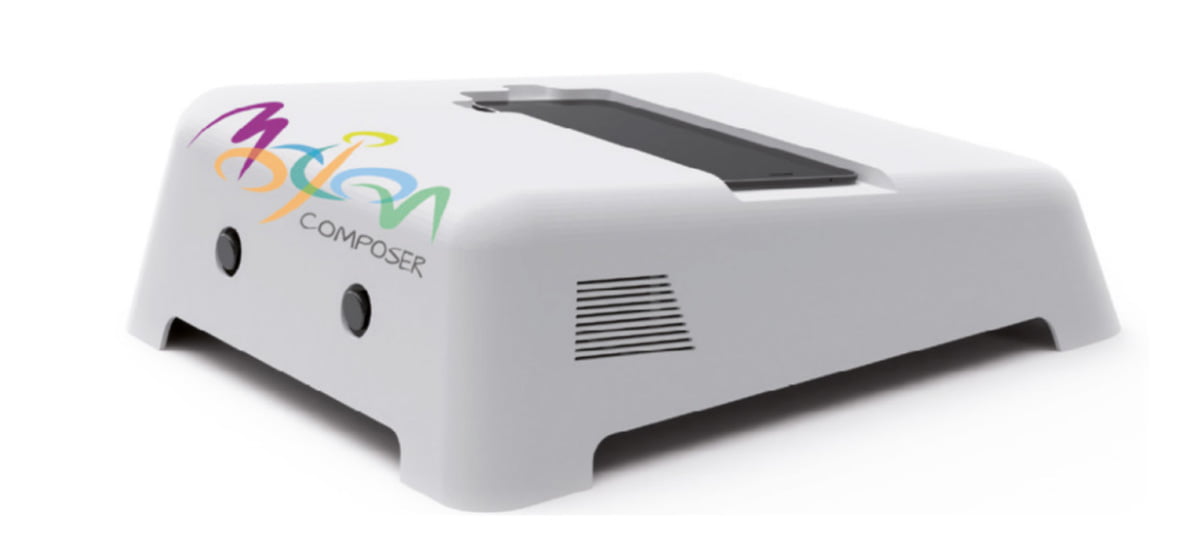

The MotionComposer                                 


It turns movement into music.

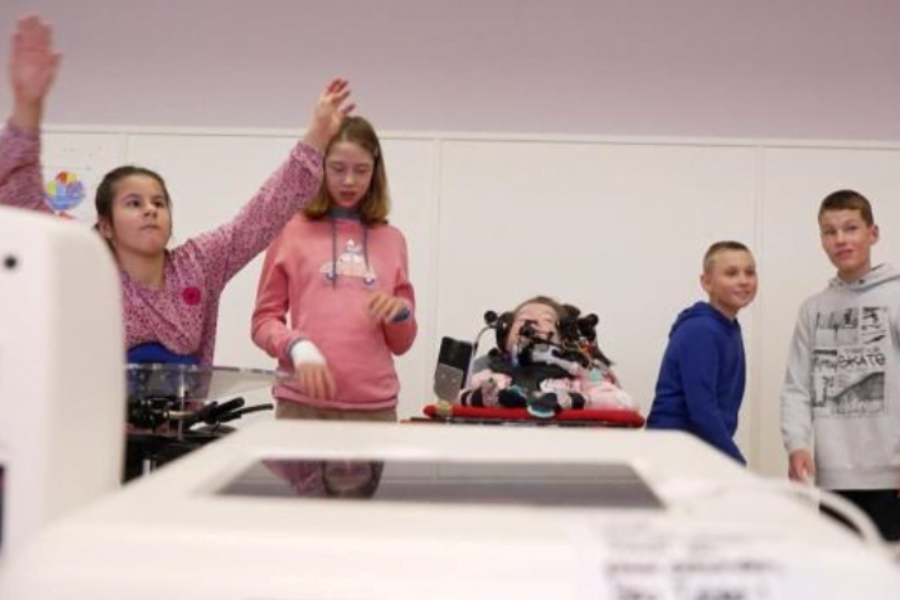
People with a wide range of handicaps, including cerebral palsy, aphasia, autism, quadriplegia, blindness, alzheimer's and parkinson's are able to express themselves musically through movement. 

With its high-resolution and low-latency technology, even people with severe disabilities, such as those who can only control finger or eye movement, or those with limited cognitive ability are stimulated and encouraged by this unique movement-music experience. Rich and varied musical environments, from classical to pop, plus clever movement-to-music mapping strategies, make the MotionComposer unique, therapeutic, and, by the way, a lot of fun!

deutsch: hier klicken


Dresden, Germany, 2012


Brno, Czech Republic, 2013

the screen shots in this video show the software EyeCon, which we are using to prototype the motioncomposer.  The final device will be based on EyesWeb and is being developed by InfoMus.


Valladolid, Spain, 2012


Valladolid, Spain, 2012


If you have trouble playing videos, or to download them, click here.


Is it a musical instrument?

Many people think we are making a new musical instrument, one that is played in the air like a Theremin. But this is not quite true.

For one thing, musical instruments are usually played with the extremities -- fingers, hands and feet. Dance, it is said, comes from the center of the body, the solar plexus. We wanted the MotionComposer to encourage all kinds of expressive movement, not just the exact "controlling" kind.  It is about the physical experience of music and dance -- sometimes you play it, sometimes it plays you. 

So is it a dance device?

This also misses the point.  It is a basic human instinct to combine music and dance. Most of the world's languages (though not English) have one word that refers to both dance and music!  This may seem strange, but it actually makes a lot of sense. The rhythms and flows of energy are the same in both music and dance.  Both can soothe and invigorate, transfix and inspire.

Dance and music are two expressions of a single urge. Small children begin to dance and make music without any understanding of what they are doing.  This "thing I have no word for", the mixture of dance and music, has been practiced by every people who have ever walked the earth.

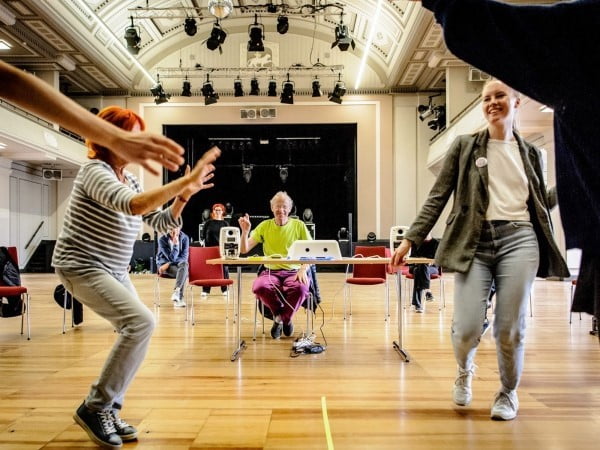
The MotionComposer is part music machine, part dance machine.  Its gets people moving, stimulates creativity and something more:  When we make music with our movements in space, it alters our proprioception -- it extends our self-image beyond the boundary of the physical body and into the environment around us.  Now when the sounds we make are beautiful, and when we are convinced that we made them, then we have a sense of joy and confidence and this leads us to move more and more, to explore and create.

This process has almost nothing to do with our mental or physical abilities, since it is based on basic instincts that live inside every human being.


Background Information

Although we and others have been tracking motionfor many years (see video samples ), the MotionComposer will make it practical and easy to use for therapists -- or anyone!

If you are a person with a disability,  or know someone who is, you can get involved.
If you are a music or dance therapist,  please get in touch.   
If you are a composer interested in interactive environments, drop us a line:  music (at) motioncomposer.org.

Workshops

Who we are

Information in German

Join us!

Our Sponsors

Contact Information

Publications

More Videos


Events 2013


Second International MotionComposer Workshop und Symposium for Composers-in-Residence, at SEAM, Franz Liszt College of Music, Bauhaus University, May 20-25, 2013.

eine interaktive Performance mit Schüler/innen der Schule am Burkersdorfer Web und Studentinnen der Palucca Hochschule für Tanz   30. Januar 2013 / 14:15

Innovationsforum Mittweida, IMM-Gruppe, Performance 20:00, 7.März 2013.


2012

Vortrag bei Tagung 'Unterstützte Kommunikation', ISAAC- Regio Sachsen. Dresden,
von Freitag, 2. November 2012 - 13:00  bis Samstag, 3. November 2012 - 16:30.

Creation Residency in Vicenza, Italy with Dr. Andrea Cera, 31.10-4.11.2012.

Vortrag and Demonstration bei EyesWeb, Casa Paganini - Infomus, Università degli Studi di Genova, Genova, Italy, 17:00, 30.10.2012.

Creation Residency in Trondheim, Norway with Dr. Andreas Bergsland, 17-23.10.2012.

Vortrag und Demonstration bei 22. Internationale Wissenschaftliche Konferenz, 11:50, 25.10.2012, Workshop 15:30.  Mittweida, Germany

Workshop für Menschen mit und ohne Behinderung, Einstein Kultur Zentrum , München. 13-14.10.2012.  Zusammenarbeit mit Komponist Goran Vejvoda.

Vortrag bei »Innovative Computerbasierte Musikinterfaces«, Mensch&Computer, Konstanz, 10.9.2012.

Composer Adrien Garcia, sound environment design residency II, Bauhaus University, Weimar, 17-23.Sept, 2012

Palucca Schule Dresden, Workshop for Dance with Persons with Disabilities and MotionComposer, Sept 19, 2012 until Spring 2013

Deutsche Welle Television, Reportage über MotionComposer Erfinder Robert Wechsler, August 23, 2012.

Ostrale'012 , Workshop Event, Dresden, July 27-Aug 2.

Comprovisations Workshop and Conference, at Hexagram, Concordia University, Montréal, Canada, Demo-Performance, May 24-27, 2012.

Workshop in Valladolid Spain with persons with disabilities, students and therapists, 2-12.5.2012.

Workshop and Symposium with composers in residence, at SEAM, Franz Liszt College of Music, Bauhaus University, May 23-29, 2012.

Colloquim:  Music in Aging - Music as Opportunity, Landesmusikrat Hamburg e. V.
13th and 14th, April 2012.

CeBit, 06. bis 10. März 2012, Hannover.

LearnTec Messe, Karlsruhe, 31.Jan - 2.Feb, 2012.

Workhshop + Roundtable, CIRMMT, McGill University, Feb 27-March 2, 2012.

2011

Workshop bei Schule am Burkersdorfer Weg, Dresden, Oct 31 - Nov 5, 2011

Presentation, Pure Data Conference, Weimar, Germany Aug 12, 2011

2010

Workshop with children with disabilities with Dr. Alicia Acitores, FUNDACIÓN MÚSICA ABIERTA, Valladolid, Spain, March 25-30, 2010


Der MotionComposer

Ein intuitiver Ausdrucksvermittler für Menschen mit Behinderung -– ein Gerät, das Bewegung in Musik verwandelt.

Die Idee ist einfach: Wer sich bewegen kann, der kann auch tanzen und musizieren. Dies sollte nicht davon abhängen, wie groß und ausführlich die Bewegungen sind oder welchen Teil des Körpers man bewegen, bzw. nicht bewegen kann.

Mit dem Team MotionComposer entwickeln wir an der Bauhaus-Universität eine neue Möglichkeit des Körperausdrucks und der Bewegungsaktivierung für Menschen mit Behinderung. MotionComposer steht dabei einerseits für die direkte Verknüpfung von Körperbewegung und musikalischer Klangerzeugung und zugleich für die Entwicklung eines leicht bedienbaren technischen Gerätes.

Viele Menschen mit Behinderung sind in ihrem emotionalen/kreativen Ausdruck eingeschränkt. Das führt zu Krankheiten, wie Depression und die zahlreichen Probleme, die mit Bewegungsmangel verbunden sind. Das Bewegung-in-Musik-Feedback motiviert zum körperlichen Ausdruck. Es verbessert die Körper- und Selbstwahrnehmung sowie die Koordinationsfähigkeit und Entwicklung eines realistischen Körperbildes.

Der MotionComposer kann aus jeder Bewegung, und sei es nur ein Wimpernschlag, Töne, Musik und Poesie generieren. (Videobeispiele) Damit bieten wir ein Werkzeug an, das Menschen künstlerischen und individuellen Ausdruck in einem Umfang ermöglicht, der ihnen aufgrund ihrer Behinderung bisher oft versagt blieb.


Wir bieten Workshops zum Erlernen der Motion-Tracking-Technologie, zum Komponieren eigener kreativer Klangumgebungen und zur Erarbeitung eigener interaktiver Shows an. 

Wollen Sie einen Workshop?   Hier clicken!

Neuigkeiten!


Publications / Veröffentlichungen

Alexandros Konteogergakopoulos, Robert Wechsler, Wendy Keay-Bright, 2013, "Camera-Based Motion-Tracking and Performing Arts for Persons with Motor Disabilities and Autism", book chapter to appear in Assistive Technologies, Disability Informatics and Computer Access for Motor Limitations, IGI Global.  pdf

Wechsler, R.; "Motion Tracking and Arts for Persons with Motor Disabilities -- Movement-sound coherence and the synaesthetic response", publication pending.  pdf

Dietz, Josepha; "Der MotionComposer: Bewegung in Musik verwandeln",Checkpoint E-learning.de, Interview. Link.

Billerbeck, Uwe; "Bewegung und Klang - Eine Woche mit dem MotionComposer", Unterstützte Kommunikation, 2/2012, ISAAC (International Society for Augmentative and Alternative Communication), Loeper Literaturverlag, Karlsruhe. 

Wechsler, R.; "Applications of Motion Tracking in Making Music for Persons with Disabilities", Proceedings of the 4. Workshop of »Innovative Computerbasierte Musikinterfaces«, Mensch&Computer, Konstanz, Oldenbourg Wissenschaftsverlag, 2012. pdf

Wechsler, R.; Interview in Insight Germany 05.09.12 | 16:15 - 17:00, "Robin Merrill talks to the US American dancer and choreographer Robert Wechsler about his invention", Deutsche Welle Television, Berlin. Link.

Acitores, A.P.; Wechsler, R., "DANZA INTERACTIVA CON NIÑOS PARÁLISIS CEREBRAL, XXVII Congreso de la Asociación Española de Logopedia, Foniatría y Audiología, 7, 8 y 9 de julio de 2010, Valladolid, Spain. pdf


Kontakt

Wenn Sie mehr über unsere Idee erfahren oder sich beteiligen möchten - zum Beispiel indem Sie uns bei der Test- und Entwicklungsphase unterstützen oder Musikumgebungen komponieren - kontaktieren Sie uns bitte:

Der MotionComposer


cell: +49 179 511 0400 oder +49 171 198 5035
mail: info (at) motioncomposer.org

We speak English, German, French and Spanish.


Who are we?  Wer sind wir?

Robert Wechsler - Project Director
Josepha Dietz - Licensing, Workshops, Sales and Marketing
Marcello Lussana - Project Manager, Musical Interface Coordinator
Kai-Uwe Kaden - Business Manager

Deutsch / English

Robert Wechsler ist Choreograph und Leiter eine Tanzkompanie, welche 1982 in New York gegründet wurde und 1990 nach Deutschland umgezogen ist - Palindrome Dance Company. Er ist erfahrener Universitätsdozent und war Leiter von Englands erstem Magisterprogramm in "Digital Performance" (Hull Universität 2003-2005). Er ist auch Opernregisseur (u.a. für das Theater Bonn). In den letzten zwei Jahren baute er ein Expertennetzwerk in den Bereichen Musik- und Tanztherapie auf - vor allem durch Kontakte und Workshops in Spanien und den USA. Er veröffentlichte Artikel zum Thema Motion Tracking, Tanz und Musik als therapeutisches Hilfsmittel für behinderte Menschen. (s.u.)

Robert Wechsler is a choreographer, dancer and developer of interactive methods of performing with technology. His interest in sensors and electronic devices dates back to the 1970's when he used body-worn electronic devices attached to the dancer's body. He is the director of Palindrome, a pioneer in interactive and computer-assisted performance. He holds a BFA in dance and an MFA in choreography from State University of New York at Purchase and New York University respectively. He studied ten years with Merce Cunningham and John Cage in New York and is recipient of a Fulbright Fellowship and, together with Palindrome, won first prize at the Berlin Transmediale for "best interactive art". From 2004-6, he directed England's first masters degree program in digital performance at Hull University. He is the author of articles about dance and technology in Leonardo Magazine, IEEE Technology and Society Magazine, Ballet International, Dance Magazine, Dance Research Journal, Nouvelle de Danse, Der Tanz der Dinge and co-author of the upcoming book, “Camera-Based Motion-Tracking and Performing Arts for Persons with Motor Disabilities and Autism”. He lives in Weimar, Germany.

Josepha Dietz, MA Finanzen und Marketing.   Josepha Dietz hat an der Bauhaus-Universität Weimar ihren Abschluss in Medienmanagement (M.A.) erlangt. Das im Studium vermittelte betriebswirtschaftliche und medienspezifische Wissen helfen bei der kundenorientierten Entwicklung und Vermarktung unseres auf Medientechnologie basierenden Produkts. Das im Bereich der angewandten empirischen Forschung erlangte Wissen hilft bei der wissenschaftlichen Auswertung der praktischen Erprobung des Prototypen und dient als Grundlage für eine umfassende Marktanalyse. Während ihrer Tätigkeit als Koordinatorin des Dresdner Innovationsfonds für Kunst und Medientechnologie bei der Trans-Media-Akademie Hellerau hat Josepha Dietz bereits Erfahrungen mit der Entwicklung und dem Vertrieb von auf Motion Tracking basierenden Produkten gesammelt. Als Vorstand des eingetragenen Vereins Festivalfrequenz sammelte sie Erfahrungen in den Bereichen Marketing, Finanzierung und Buchhaltung.

Marcello Lussana Is a composer and software engineer specialized in interactive systems.  These include MAX/msp, Pd, Debian GNU/Linux OS für Web Application, HTML, CSS, Python/Zope-Programmierung, Database Management (Postgresql), Analysis, creation of Gnu/linux Solutions, Web Software Development, Backoffice,
HTML und CSS kompatibel mit W3C-Standards, Zope Application Server, Python-Programmierung, Database Management und Design.

Sponsors and Partners

IMM Holding GmbH   InfoMus- Casa Paganini
   
Bauhaus Universität   Franz Liszt College of Music
   
Palindrome Dance Company   Studio for Electroacoustic Music (SEAM)
   
Bundesvereinigung Lebenshilfe e. V.   Gründerwerkstatt Neudeli


Composers and Musical Artists


   Andreas Bergsland
   Andrea Cera
   Adrien Garcia
   Dan Hosken
   Alexandros Kontogeorgakopoulos
   Giacomo Lepri
   Pablo Palcio
   Marc Sauter
   Goran Vejvoda


Dr. Andreas Bergsland is a post doctoral researcher at Norwegian University of Science and Technology with a project entitled "Live-electronics in a performativity perspective. He also teaches several courses at the Music Technology program there. Bergsland studied Musicology at NTNU with jazz bass as his instrument, which he has played in several bands since then. He finished his MA studies in 1999 with a thesis on the relationship between music and text in a symphonic song by Olav Anton Thommessen. After working as a principal in a school for cultural activities for 4 years, he gained an interest in electroacoustic music. Bergsland then received a 4-year research fellow position, culminating in a PhD entitled "Experiencing voices in Electroacoustic Music" in 2010. Bergsland has also been involved in composition for exhibitions, installations, large scale multi-media events, in addition to doing live-electronics performances and working with computer instrument design for motion capture systems.

Dr. Andrea Cera is an electronic musician, composer and sound designer. He studied Piano and Compostion in Italy (Conservatorio di Padova) and Electronic Music (Cursus Annuel de Composition et Informatique Musicale IRCAM). He has produced music for choreographers Hervé Robbe, Edmond Russo and Shlomi Tuizer, J.C.Maillot. The audio art works Innig and D-Day were commissioned by the Centre Georges Pompidou and NightRun and Reactive Ambient Music for the Fresnoy in Tourcoing. He has also composed for the music ensembles Court-Circuit, Paris and the Nouvelle Cuisine Big Band in Vienna. He also collaborated on research projects with different institutions including most recently IRCAM, Native Instruments, Renault and Notam. He lives and works at the Conservatoire de Padoue et à l'Académie de Beaux Arts de Brera in Milan. Starting in 2011 he became project designer for the sound of Renault's new generation of electric cars (including work with persons with handicaps).

Adrien Garcia is a musician, composer and interactive media artist. He studied composition in France and digital arts in Québec. He plays the piano, the guitar, the electric bass, the sitar and the shakuhachi. He works in collaboration with therapists as a music composer or as a consultant to develop art-therapy workshops using digital tools. With similar aims and approaches than art therapists, he creates interactive installations allowing people to free their creativity and helping them to improve the way they interact with their environment. He received an excellence grant from Sennheiser in sound creation and new media in 2010 and in 2011. He is currently living in Orbey, France.

Giacomo Lepri is a musician, composer and sound designer. He was born in Genoa in 1988, he approached the world of music through the piano and especially Afro-American music culture and Jazz. He has also studied the typical percussive instruments of the Afro-Cuban and Brazilian tradition. His work in electronic music began in 2005, and since 2012, after a period of study at the University of Edinburgh as visiting student, he graduated in Electronic Music at the Conservatory N. Paganini of Genoa.
He now works as sound designer in the international center of reaserch Infomus Lab – Casa Paganini of the University of Genoa. His compositions have been presented in different gallery and in a variety of musical events in Italy, Spain, Portugal, UK and Germany.

Pablo Palacio is an independent composer currently living in Madrid. His work has been focused on the transformation an perceptual connections of sonic images. He has held residences in Spain, Switzerland, Germany and Libanon, and his pieces have been performed in many countries from Europe and United States to China, India, Brasil, Australia or North Africa. He is also an active composer for dance and performing arts receiving commissions from, Palindrome Inter Media Performance Group (Weimar, Germany), Staatstheater Mainz (Mainz, Germany), Maqamat Dance Theater (Beirut, Libanon) or Cisco Aznar (Switzerland) among others. He also collaborates with several conservatories, universities and institutions through publications, workshops, and talks divulging new perspectives and technologies in sound composition. He is invited lecturer of sound space at the Master in Performing Arts and Visual Culture (UAH-Madrid).


InfoMus Lab, founded in 1984, carries out scientific and technological research, development of multimedia systems, multimodal human-computer interfaces, and applications. A main research focus is on the understanding and development of computational models of non-verbal expressive and social behavior. Cross-fertilisation of scientific, humanistic, and artistic theories characterize the research methodology. From 1997 to 2004 InfoMus Lab had a contract with the Genoa Opera House - Teatro Carlo Felice which included a lab site at the theatre and joint activities.

The MotionComposer software is based on the multimedia software platform EyesWeb, conceived, designed, and developed by Casa Paganini - InfoMus, is adopted by thousands of users worldwide for scientific research, education, and industry applications. EyesWeb was selected by INTEL in 2008 for their hardware for "independent living".


Consultants

   Dr. Antonio Camurri - Consultant for Motion Tracking
   Klaus Nicolai - Consultant for Development
   Mathias Reinhardt - Consultant for Development
   Professor Jens Geelhaar - Consultant
   Giselher Grenzdoerfer - Constultant
   Frieder Weiß - Consultant for Motion Tracking Technology


Video Download

This video (right-click to download)  combines all of the videos at this website in one movie.

Format:  Quicktime (*.mov), 384x288, 150 MB, 12 min, 964 kbps, audio: 32khz , PCM, 16bit.

If you have trouble playing our videos, or if there is something different you would like, let us know! 

If you would like a DVD, let us know.


Write to:  info (at symbol) motioncomposer.org.


This is a temporary web site.

Its design is borrowed from the Palindrome Inter.media Dance Company

It was designed by:
Julia Jüstel @
Tocologo Kommunikationsdesign
www.tocologo.de